Australia’s Sportstech Sector Revenue Surges to A$7.11 billion
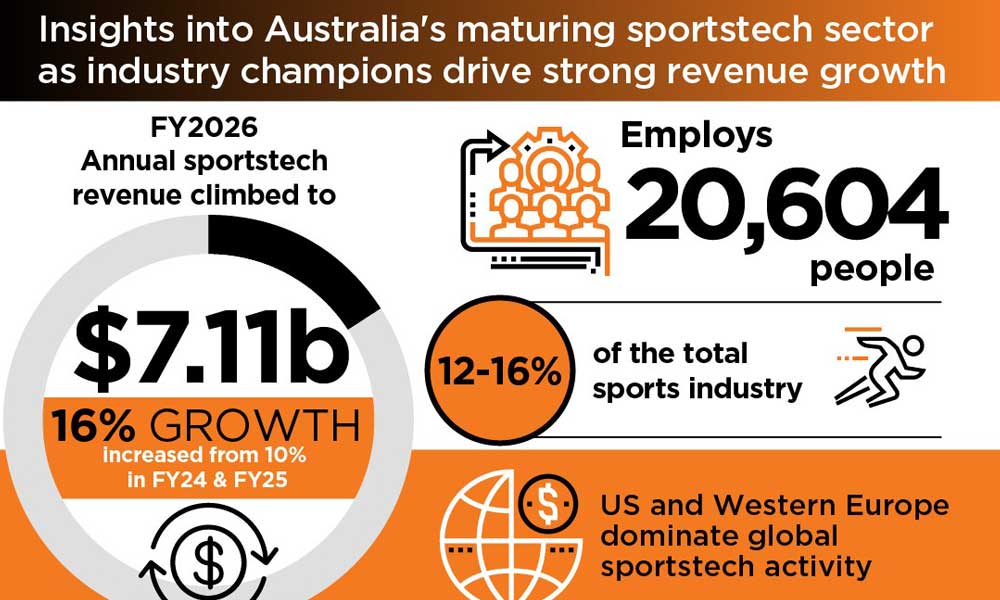
The Australian Sports Technologies Network (ASTN) has reported a sharp acceleration in Australia’s sportstech sector, with revenue growth rising from 10% in FY2025 to 16% in FY2026, reaching A$7.11 billion. Industry employment also expanded by approximately 6% to 20,604 employees, reflecting strong sector growth and rising demand for talent.
The Fifth Edition of ASTN’s annual report provides a comprehensive census of Australia’s sports innovation sector, identifying 924 companies nationwide. Driven by a portfolio of successful fast scaling sportstech companies, the Top 115 companies generate 89% of total revenue (A$6.30 billion) and 74% of employment (15,201 roles). This reflects a sector of category leaders that are succeeding in global markets and driving economic impact, as well as companies that have become market leaders in Australia.
While the APAC region currently accounts for only around 10% of global sportstech activity, Australia’s reputation as an innovation hub continues to strengthen internationally. “Australia’s sportstech sector is experiencing sustained growth and reaching unprecedented momentum on the global stage. We are seeing a growing number of fast-scaling companies emerge – companies that are successfully competing in global markets while building strong market positions at home. Their success is driving revenue growth, employment and international recognition for Australia as a sportstech innovation hub,” said Dr Martin Schlegel, Chair, Australian Sports Technologies Network (ASTN).
“This is reflected in the growth in economic value and employment driven by companies including Catapult Sports, PMY Group, Bodd, VALD and Champion Data, alongside a broader cohort of Australian companies achieving global success,” said Dr Schlegel.
The report highlights that Australia’s strong sporting ecosystem, including major sports events calendar, world-class sporting facilities and sports fandom, provides a strong foundation for sportstech innovation and global scaling opportunities.
However, the findings suggest Australian sportstech startups are increasingly taking a ‘global-first’ approach, seeking early validation in overseas markets to accelerate commercial growth. This shift is partly driven by ongoing challenges engaging with Australian sport organisations and corporates, which can limit early domestic traction.
“Australia has the capability to be a leading testbed for sportstech innovation, yet many startups still struggle to secure early domestic traction. As a result, more companies are seeking validation and scaling overseas first, meaning Australia is often missing the opportunity to support and benefit from early-stage growth. There is a critical opportunity to strengthen collaboration between startups and sport and corporates to ensure innovation is captured and scaled earlier,” said Dr Schlegel.
“By moving decisively now, Australia can leverage Brisbane 2032 to accelerate long-term industry growth and establish a sustainable global competitive advantage in the rapidly expanding sportstech market,” concluded Dr Schlegel.
KEY 2026 REPORT FINDINGS:
- Record Revenue Growth: The sportstech sector is now worth A$7.11 billion annually, with annual growth accelerating to 16% (from 10% in FY25 & FY24).
- Rising Employment: Employment grew by 6% to more than 20,600 people.
- Market Leaders Driving Growth: The top 12% of companies continue to generate 89% of the sector’s revenue and 74% of employment.
- Maturing Sector: The sector has settled into a stable, increasingly mature stage of its lifecycle, marked by consistent revenue growth and a plateau in year-on-year growth in the number of companies – growing only by 1.8% in FY26.
- Total Sports Industry: The sector now accounts for an estimated 12-16% of Australia’s A$45 billion sports industry.
- Expansion Beyond Sport: More than one in four sportstech businesses now service adjacent industries including health, defence, events, media and education.
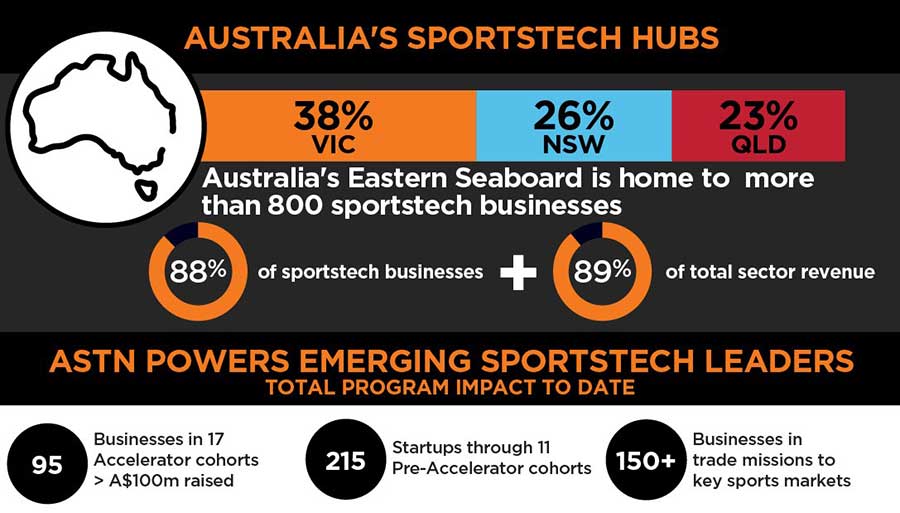
- East Coast Dominance: Victoria (38%), New South Wales (26%), Queensland (23%) and the ACT (1%) account for 88% of Australia's sportstech businesses, reinforcing the concentration of activity along the eastern seaboard – this accounts for 88% of Australia’s 924 sportstech businesses and more than 93% of sector revenue and employment.
- Victoria and Melbourne Lead the Way: Victoria remains Australia's leading sportstech state, with Melbourne at the heart of the ecosystem, accounting for 39% of total sector revenue.
- Queensland’s Rise: South-East Queensland continues to strengthen as a sportstech hub, supported by investment ahead of Brisbane 2032. Queensland is forecast to overtake New South Wales in business numbers and employment by FY2028.
- Increased M&A and Capital Raising: Global sportstech transactions reached US$117 billion in 2025, while Australian leaders continued to attract significant investment.
- Global Sportstech Ecosystem: The United States and Western Europe continue to dominate global sportstech activity. APAC region currently accounts for around 10% of global sportstech activity.
- Women in Sportstech: Women founders represent 8% of sportstech (down from 9% in FY2025), compared to 19% in ASTN programs.
- Future Sportstech Trends: Artificial intelligence in sport, esports and international trade are some of the key themes that are expected to drive future growth in the sportstech sector in coming years.
- ASTN Fuels a New Wave of Growth Leaders: 95+ companies across 17 cohorts of Accelerator programs have raised A$100 million. 215+ startups across 11 cohorts of Pre-Accelerator programs. 150+ companies in trade missions to 10 countries.
Official launch event at Cremorne Digital Hub (CBH), Wed 15 July 2026 | 5.30PM
The report will be officially launched at ASTN’s member event at Cremorne Digital Hub (CDH) on Wednesday, 15 July 2026. This event will be attended by government, industry leaders and entrepreneurs including Ashling James, Director, Digital Economy | Industry & Innovation, Department of Jobs, Skills, Industry and Regions.
Quote to be attributed to Victorian Minister for Economic Growth and Jobs, Steve Dimopoulos: “The report cements Victoria as Australia’s leading sportstech state, as well as the nation’s sporting capital,” said Victorian Minister for Economic Growth and Jobs Steve Dimopoulos, “it reflects our strengths in innovation, investment and our passion for world-class sporting events.”
-ENDS-
For more information about the report, or to speak to an ASTN spokesperson, please contact ASTN’s Communications Manager, Tara Ballard, at tara.ballard@astn.com.au | 0436 330 267