My Concussion Passport: Giving grassroots athletes the concussion protocols elite sport already has
A recent Four Corners story changed that, highlighting that concussion is not just a professional issue, and extends to the community and junior levels where it remains a genuine blind spot. My Concussion Passport, built by a four person Melbourne team, is a digital "traffic light" concussion record designed to close that exact gap.
My Concussion Passport is a secure digital platform that simplifies concussion management and communication across all sports and schools. Each athlete is provided with a unique, lifelong digital concussion passport and ID, holding their concussion status and history. All affiliated environments that an athlete has linked to their passport, whether that be a club, school or league, can view the athlete’s current concussion status, report an incident and request updates. An athlete’s full concussion history remains private and is only visible to the athlete and their treating, suitably qualified healthcare practitioner, and, in the case of a junior athlete, their parent or guardian.
"As a practitioner, I've seen firsthand how fragmented and outdated concussion information puts young athletes at risk," says Dr David Munro, co-founder of My Concussion Passport. "My Concussion Passport creates a single, secure digital record that follows the athlete across every team and competition, giving coaches, parents and medical staff real-time visibility of concussion status. Multiple international organisations and sporting bodies have repeatedly called for a concussion passport, and we now finally have a world-class, best-practice system."
A police detective, a physio and a friendship built on grassroots sport
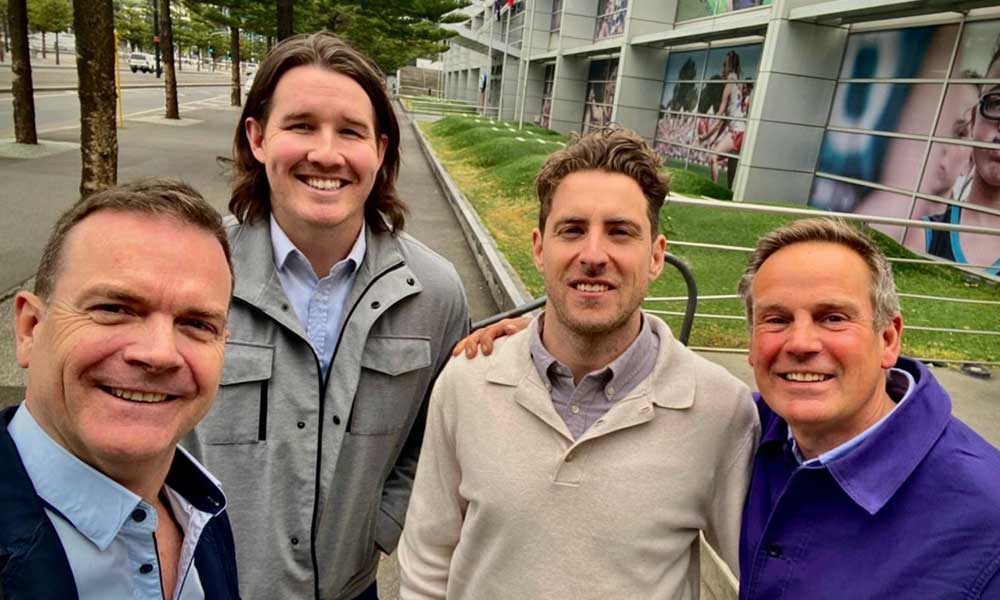
My Concussion Passport was founded through a shared belief that community and junior athletes deserve the same standard of concussion management as professional athletes. Co-founders Jacob Gooden, a medically retired police officer turned community safety tech founder, and Brett Carty-Salmon, a senior product and design leader with more than twenty years' experience releasing innovative software solutions, first met while participating in LaunchVic's CivVic Labs Challenge, each developing separate startups focused on improving community safety. As their friendship grew, they discovered a mutual passion for grassroots sport and kept returning to one persistent problem: while elite athletes benefit from sophisticated concussion protocols and communication systems, community and junior sport continues to rely on fragmented, inconsistent processes.
Determined to bridge that gap, Brett invited Dr David Munro to join the founding team. Dr Munro, a concussion-trained physiotherapist and researcher of more than 30 years, and current APA ex-officio National Concussion Officer, and founder of one of Australia's earliest dedicated concussion practices, brought clinical expertise that helped shape the vision of a secure, athlete-owned digital concussion passport that could follow participants throughout their sporting journey. To build that vision on a secure and scalable foundation, Jacob recruited his lifelong friend Naish Campbell, an IT and cybersecurity professional, completing a founding team that combined lived experience, clinical expertise, product design and technology.
The blind spot in Australia's concussion response
Every week, millions of junior and community athletes compete across multiple teams, in various codes, at different clubs, schools and standards. Communication between them is extremely fragmented: sporting bodies, schools, healthcare practitioners, athletes and parents don't have one clear picture in the event of a concussion. The result is poor athlete welfare, inconsistent reporting, unclear return-to-play decisions, and a growing administrative and legal burden on organisations. Currently, a junior athlete can sustain a concussion in one setting and, without intervention, return to play in another, with no centralised system of record connecting the two.
The stakes of that gap are real. In February 2026, the Northern Territory Supreme Court found in Melville v. NCFC, NTAFL, AFL that "all three defendants [the Club, the League and the AFL] should have prevented players who had ongoing symptoms from previous concussions from playing," and that the plaintiff had "suffered injury, loss and damage" as a result. It's exactly the kind of fragmented, undocumented decision-making that My Concussion Passport is built to prevent.
A traffic light that follows the athlete
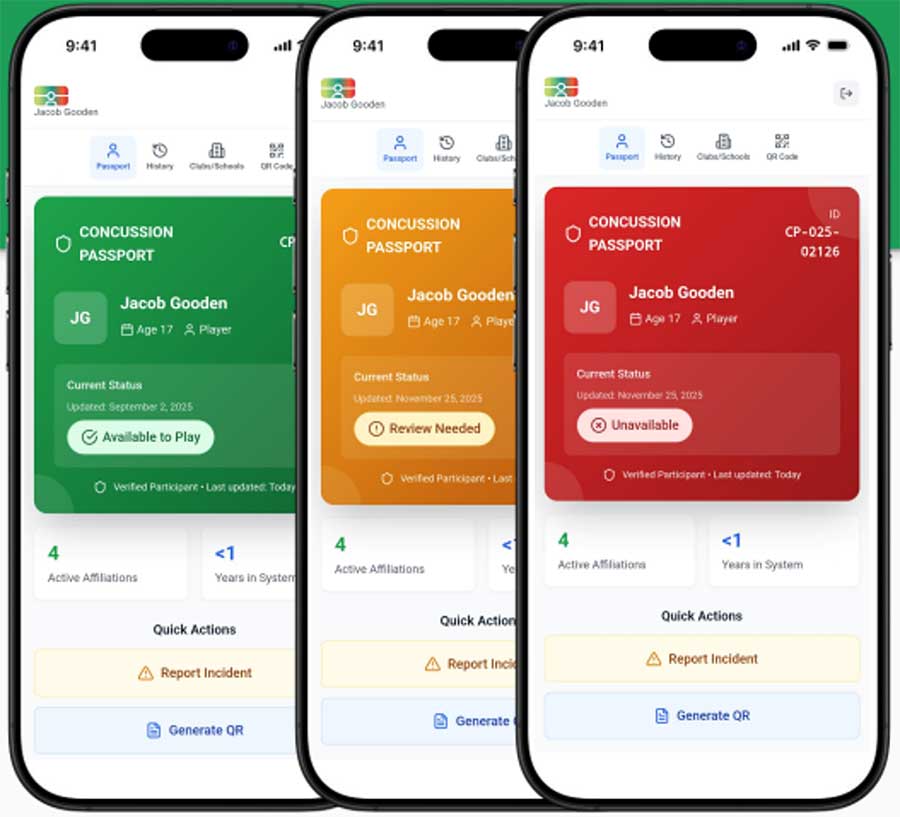
My Concussion Passport gives each athlete a secure digital concussion passport with a unique ID. Any suspected concussion can be logged in seconds by a school or club representative or parent, and a clear traffic-light system makes status instantly visible: green for available, amber for a suspected concussion (unavailable pending medical assessment), and red for a diagnosed concussion (unavailable and progressing through return-to-play protocols). Healthcare practitioners update an athlete's status in real time via a unique QR code, and all linked schools, clubs, leagues and parents receive immediate notifications.
Privacy is built into the design: only an athlete's current concussion status is shared between organisations. Full concussion history is visible only to the passport owner and their treating practitioner, maintaining privacy while strengthening safety and accountability. The platform aligns with Australian Institute of Sport guidelines, giving schools and clubs a defensible, auditable process that strengthens duty of care and reduces organisational risk.
Proof at Sunraysia, and a platform ready to scale
Since launching, My Concussion Passport has onboarded organisations across football (Australian Rules), netball, cricket, gymnastics and judo. The most significant of these has been the Sunraysia Football Netball League, based out of Mildura, a partnership independently covered by ABC National News. To date, the operation has been entirely bootstrapped, with 2025 serving as a no-cost trial year for onboarding organisations.
The scale of the problem the platform addresses is substantial: more than 3.5 million Australian children take part in organised sport or physical activity each year, including more than 700,000 community sport participants in Victoria alone. My Concussion Passport's own timeline reflects rapid early progress, the company formed in January 2025, went live in March 2026, onboarded its first organisations in June 2026, and tracked its first concussions through the system the following month.
The platform has also drawn endorsement beyond its founding team. "A major concern in concussion management is the disconnect in tracking an athlete's concussion status across different sports, and for junior athletes, between their club sport and school," says Professor Alan Pearce, an internationally recognised neurophysiologist and concussion researcher. "My Concussion Passport addresses this gap, ensuring all stakeholders can provide the athlete with the best possible management for their long-term health and sporting future."
Former Suncorp Super Netballer and AFLW player Samantha Gooden has spoken to the platform's value in removing the stigma athletes feel around an "invisible" injury: "Telling a coach or team that you're unable to play due to a seemingly invisible injury from another sport or team is difficult, and I never wanted to feel like I was letting down my teams or coaches. My Concussion Passport is a solution that removes the guilt the athlete feels and allows effective communication across teams to protect players' health and wellbeing."
ASTN's role
My Concussion Passport was approached directly by ASTN, who reached out to the team through Dr David Munro. The company went on to complete ASTN's Pre-Accelerator Cohort #10, an experience the founders describe as revealing just how much nuance there is in applying startup fundamentals within the sports industry specifically. The program's greatest value, they say, was the ability to tailor those fundamentals to their business, challenge their thinking and validate strategic decisions while identifying areas to strengthen. Since completing the program, access to the ASTN network has continued to prove valuable, through collaboration opportunities, mentor connections, and a community of founders who understand the isolating nature of building a startup.
"Sport is such a unique industry," says Jacob Gooden, Co-Founder. "We'll read every book and study available to improve the way we deliver our solution, but at the end of the day, this is a hands-on caper. There is no substitute for learning from people who have been there, done that, and are still doing it. The ASTN and the Victorian sportstech ecosystem have become a vital touchpoint for us as we continue to grow."
What's next
The team makes no secret of its ambition to become the standard in concussion management and communication. Their vision is for My Concussion Passport to become the mandated platform adopted across sports where concussion carries inherent risk, with every athlete assigned a digital passport as a condition of participation, eligibility to compete underpinned by a simple principle: an athlete must hold an active green concussion status to take the field.
The product has been developed and validated in the field, and the team sees the challenge ahead as no longer proving the technology but accelerating adoption. That's where they see ASTN playing a continued role, using its network and influence to facilitate introductions to the sporting organisations, governing bodies and decision-makers responsible for setting minimum standards across sport, and helping put My Concussion Passport in front of the people who can help shape the future of concussion management and communication in Australia.
Find out more about My Concussion Passport
My Concussion Passport: myconcussionpassport.com.au
Read more on ABC National News's coverage of the Sunraysia Football Netball League partnership.
Hear from Dr David Munro in his interview with Tom Morris on SEN.